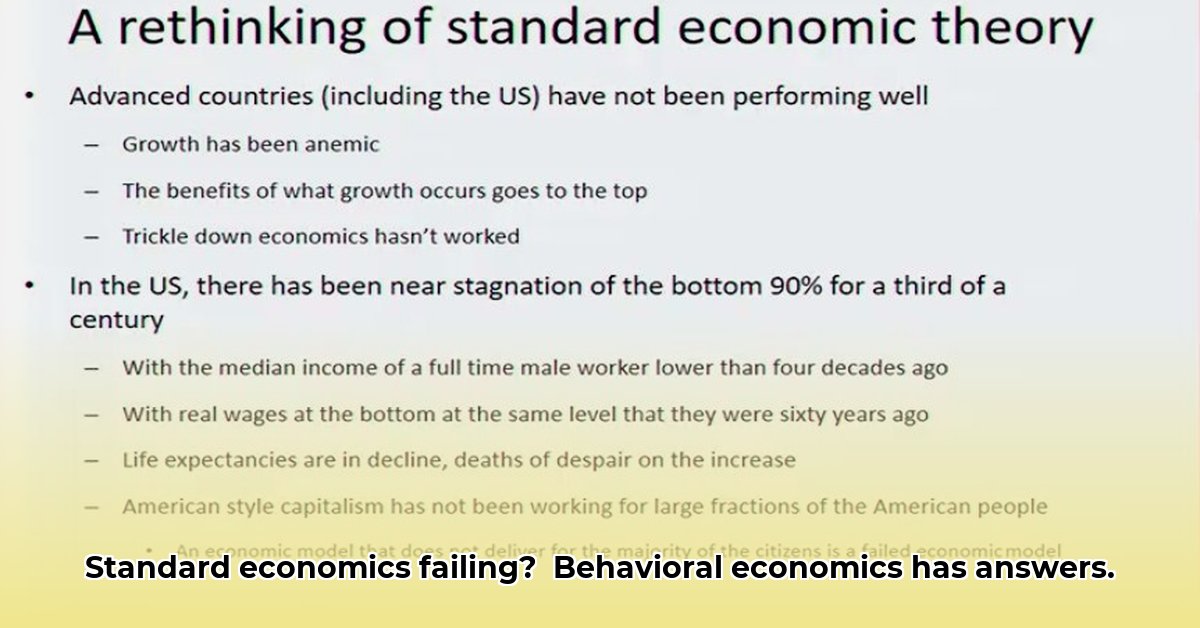
Standard Economic Theory: A Foundation with Flaws
Standard economic theory (SET), also known as the standard model, rests on the assumption of homo economicus – the perfectly rational individual who always makes choices to maximize their self-interest. While this simplified model provides a useful framework for understanding basic economic principles, its limitations become glaringly obvious when confronted with the complexities of real-world behavior. Does everyone always meticulously calculate the marginal utility of every purchase? Highly unlikely. This inherent flaw leads to inaccurate predictions and ineffective policies in many situations. Behavioral economics offers a more nuanced perspective, acknowledging the impact of psychology and social factors on decision-making.
Behavioral Economics: Adding the Human Element
Behavioral economics bridges the gap between theoretical economic models and observable human behavior. It recognizes that individuals are not always perfectly rational; their choices are often influenced by cognitive biases, emotions, social norms, and the way information is presented. This more realistic approach leads to more accurate predictions and more effective policy interventions. For example, the "framing effect" demonstrates how the wording of a choice can dramatically alter preferences, even when the underlying options remain the same. Would you rather buy a product described as "90% fat-free" or "10% fat"? Most people choose the former, highlighting the power of framing on consumer decisions. Similarly, the "free-rider" problem shows how the availability of free resources can lead to overuse, even when individuals recognize the need for collective contribution.
Key Takeaways:
- SET assumes perfect rationality, neglecting cognitive biases and emotional influences.
- Behavioral economics incorporates psychological and social factors into economic models.
- This more nuanced approach leads to more accurate predictions and effective interventions.
Standard Economic Theory vs. Behavioral Economics: A Critical Comparison
The core difference lies in the assumptions about human behavior. SET assumes perfect rationality and complete information, leading to predictable outcomes within simplified models. Behavioral economics, however, acknowledges "bounded rationality" – the idea that our cognitive abilities and information processing are limited, making perfectly rational decision-making impossible. Additionally, it recognizes the strong influence of social and emotional factors on choices. This leads to different predictions and policy implications. A notable example of this contrast is the effectiveness of "nudges" – subtle alterations of choice architecture – in influencing behavior in ways that traditional incentives might not.
| Feature | Standard Economic Theory | Behavioral Economics |
|---|---|---|
| Rationality | Perfect rationality, self-interest maximization | Bounded rationality, influenced by emotions and biases |
| Information | Complete and readily available information | Incomplete, unreliable, unevenly distributed information |
| Predictability | High precision in simplified settings | More realistic, nuanced predictions, potentially less precise |
| Interventions | Primarily focused on incentives and price mechanisms | Leverages nudges, framing effects, and social norms |
Actionable Implications: Applying Behavioral Insights
The insights gleaned from behavioral economics have significant practical applications across various sectors:
1. Policymakers: Behavioral insights can drastically improve policy effectiveness. For example, framing a tax incentive as a "bonus" rather than a "reduction" can significantly increase participation. Similarly, setting defaults to encourage desirable behaviors (like organ donation opt-out programs) demonstrates the power of subtle design choices.
2. Businesses: Companies leverage behavioral principles to optimize marketing, product development, and consumer engagement. Loyalty programs, personalized recommendations, and strategic product placement all rely on an understanding of psychological tendencies.
3. Researchers: Interdisciplinary research involving economists, psychologists, and sociologists continues to refine and expand our understanding of behavioral economics. This ongoing exploration is crucial for developing more effective and nuanced models.
4. Educators: Integrating behavioral economics into economic education equips students with a more complete and realistic understanding of human behavior in economic contexts. It moves beyond simplified models to the complexities of real-world markets.
Conclusion: A More Holistic View of Economics
While SET provides a valuable foundation, incorporating the insights of behavioral economics is essential for creating more accurate and effective models of economic behavior. By understanding the psychological and social influences on decision-making, we can develop better policies, more effective business strategies, and build a more robust understanding of how economies truly function. The future of economics lies in this integration, allowing for a more comprehensive and human-centric approach.